
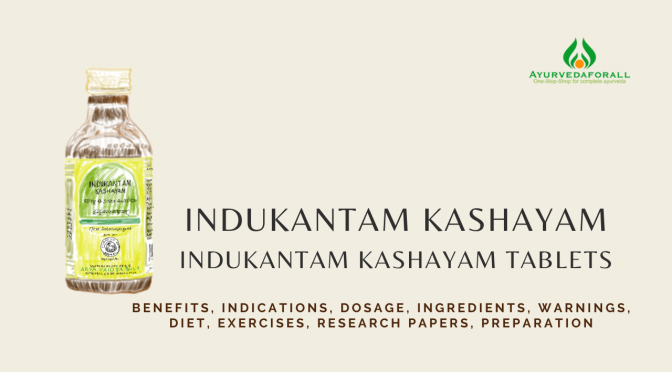
Indukantham kashayam is an Ayurvedic medicine for improving health and immunity. We have loud applause for this medicine during the Covid19 times. In the present scenario, it is used widely as an immunity modulator. It also helps to treat chronic and intermittent fevers.
Indukantham kashayam Benefits
The formulation of Indukantham is explained as a ghrita yoga in Malayalam text Sahasrayoga but it is used as a kashayam more often. In today’s world people are affected by many types of derangement in fat metabolism; may it be Hyperlipidemia or obesity or hypercholesteremia or atherosclerosis or hypertension. Most of these, associated with weak digestion, too. In such people, the ghee preparation may worsen the condition rather than curing it. But the same herbs in a water-soluble form in the decoction can act as the cure for many such derangements, even for hypercholesterolemia.
It is very effective in allergic respiratory diseases like bronchitis especially when the patient is physically weak. By boosting the immunity, the severity and frequency of respiratory infections reduce.
In the traditional Ayurveda, this combination is used to regain health after a fever or any infectious disease.
Children who do not eat well can be managed by a combination of Indukantham and Ashta choornam the former being in either Kashaya or Ghrita form according to the child’s Prakriti and Agni. By improving digestion, this combination improves taste and appetite; the bioavailability of nutrients in the food also enhanced. Hence the child starts eating well and his general health improved. Any kind of deficiency would also be corrected.
Indications
Vaatamaya – Diseases of Nervous and locomotory system, mostly degenerative.
Kshaya – any tissue degenerative diseases that weaken the organ or the patient including tuberculosis
Mahodara – ascitis
Gulma – Distention, bloating and pain in the abdomen associated with indigestion.
Soola – Various kinds of abdominal pains including colic, appendicitis, and peptic ulcer.
Nimnonnatajwara – Recurrent fever
Balavardhanam – useful in increasing power, including immunity.
Indukantham kashayam Ingredients
| Indian elm
|
Poothika
|
Holoptelea integrifolia
|
It has anti-diabetic, wormicidal, and wound healing properties. It is beneficial in healing hemorrhoids.
| Himalayan cedar
|
devadaru
|
Cedrus deodara
|
It is useful as an expectorant in cough. It relieves asthma and other respiratory diseases by clearing the airways and enhancing the movements of the respiratory tract.
It has an anti-diabetic effect as it helps reduce high blood sugar levels in the blood.
It helps to calm the mind and improves sleep quality.
Dasamoola
It is a group of roots of ten herbs used as a combination in many formulations in Ayurveda.
The ten plants included in Dasamoola are,
| Indian bael | Bilwa | Aegle marmelos |
| Headache tree | Agnimantha | Premna integrifolia |
| Indian trumpet flower | Syonaka | Oroxylum indicum |
| Yellow snake tree | Patala | Stereospermum suaveolens |
| Beechwood | Gambhari | Gmelina arborea |
| Indian nightshade | Brhati | Solanum indicum |
| Yellow-berried nightshade | Kantakari | Solanum xanthocarpum |
| Sal leaved desmodium | Shaliparni | Desmodium gangeticum |
| Dabra | Prishniparni | Uraria picta |
| Puncture vine | Gokshura | Tribulus terrestris |
Used together as a combination in Ayurvedic formulations, Dasamoola has Anti-inflammatory and analgesic properties. It works as a strong anti-rheumatic agent. It is useful in reducing edema. Being mainly Vaatahara it gives strength to the body. It is useful in all diseases related to nerves and muscles.
Shadpala
It is a group of 6 drugs, used as a combination in many ayurvedic formulations.
The drugs are,
| Long pepper | Pippali | Piper longum |
| Long pepper | Pippaleemoola | Piper longum |
| Kaattu mulak | Chavya | Piper attenuatum |
| Ceylon leadwort | Chitraka | Plumbago zeylanica |
| Ginger(dried) | Naagara | Zingiberofficinalis |
| Rock salt | Saindhava |
The first five drugs, together known as Panchakola and adding Saindhava, it becomes Shadpala known for its potency to improve digestive fire and in clearing the blocked channels.
Details of the manufacturing
As already discussed, Indukantham kashayam is prepared using both the kashaya herbs and the Kalka herbs in the ghrita yoga as its ingredients with a distinct ratio.
All these ingredients should be washed well and dried up in shade.
Take the prescribed herbs in dried & crushed form in an earthen pot. For your special attention, Naagara should be crushed and tied up separately in a white clean cotton cloth as a Potali. This is to prevent the excess dissolution of the contents and to maintain the exact consistency of the kashayam. Now add 16 times clean water into it. Make it boil and then cook in the open vessel with low fire. Reduce the quantity into one by the eighth of the initial quantity. Make sure to mix it in between with a ladle without breaking the potli. Also, the fire should be kept low to make sure that all the active ingredients in the herbs needed are absorbed well into the water. Once the quantity is reduced to one by eighth of the initial amount of water, remove the vessel from the fire. Squeeze and drain through a clean white cloth. Collect the decoction in a clean vessel and discard the solid waste. Drink the mild warm decoction.
Dosha Dooshya Predominance with roga marga.
Indukantham kashayam is Vaata kapha hara.
It acts on aabhyantara rogamarga
Dosage and Usage of Indukantham kashayam
Dosage:
Two Pala. (120Ml) This is the dosage of freshly prepared Kashayam. Now for convenience, concentrated Kashayam is available. The dosage is 15 ml Kashayam mixed with 45- 60 ml boiled water twice daily before food.
Kashayam tablets are also available and the dosage is Two to Three tablets twice daily before food.
Usage:
Kashayam is advised to take in empty stomach, once the ingested food is digested well and aahaara rasa is formed well.
Usage of kashayam with prescribed prakshepa dravyas according to the condition of disease and the patient gives the best results mostly.
Exercises and Yoga.
As Indukantam kashayam targets mainly the respiratory system and immunity, only mild exercises are advised. Also, specific Yogacharya including naadi shuddhi pranayama, bhujangaasana, is recommended.
Regular exercise helps improve the bioavailability of medicine and food ingested and leads to positive health.
Yoga can maintain harmony within the body and with the surrounding system.
Nadisudhi pranayama
Bhujangasana
Simple exercises for lungs and heart health
All the exercises and physical exertions must be decided and done under the supervision of a medical expert only.
Recommended diet and behavior
Diet:
- To be avoided
Heavy meals and difficult to digest foods – cause indigestion.
junk foods- cause a disturbance in digestion and reduces the bioavailability of the medicine
carbonated drinks – makes the stomach more acidic and disturbed digestion
refrigerated and frozen foods – causes weak and sluggish digestion by weakening Agni (digestive fire)
Milk and milk products – increase Kapha and cause respiratory problems
curd – causes vidaaha and thereby many other diseases
- To be added
Light meals and easily digestible foods
Green gram, soups, honey, fruits and vegetables, dry fruits and nuts in moderate quantity.
freshly cooked and warm food processed with cumin seeds, ginger, black pepper, ajwain, etc
Behavior for Indukantam Kashayam:
Protect yourself from a cold climate.
Better to avoid exposure to excessive sunlight, wind, rain, or dust.
Maintain a regular food and sleep schedule.
Avoid holding or forcing urges like urine, feces, cough, sneeze, etc.
Indukantam Kashayam Side Effects
No known side effects reported.
Classical references with the image of the text of Indukantam Kashayam.

Equivalent medicines.
Shadpala ghritam in Ashtanga hridayam
Ksheerashadpalaghrtam in Sarngadharasamhita
Udakashadpalaghrtam and dasamoolashadpalaghrtam in sahasrayogam
All these are similar combinations for ghee preparation.
Brands Available
AVS Kottakal
Oushadhi
Vaidyaratnam oushadhasala
AVP Coimbatore
Nagarjuna Ayurveda
Kerala Ayurveda
Research papers
Indukantham kashayam and ghritam
Devadaru
effect on ulcer and acidity
https://www.sciencedirect.com/science/article/abs/pii/S0378874110008950
Antileishmanial and immunomodulatory
https://pubmed.ncbi.nlm.nih.gov/29664038/
anti-inflammatory and analgesic
https://pubmed.ncbi.nlm.nih.gov/10350366/
A study on dasamula and its anti-inflammatory effect
In vitro antioxidant and anti-inflammatory activities of aqueous extract of an Ayurvedic formulation Dasamula and its herbal ingredients: A comparative study
- Mahadevan1, V. Vadivel2, P. Brindha3
1School of Chemical and Biotechnology, SASTRA University, Thanjavur, Tamil Nadu, India, 2Chemical Biology Lab, SASTRA University, Thanjavur, Tamil Nadu, India, 3Deparrtment of CARISM, SASTRA University, Thanjavur, Tamil Nadu, India
Abstract
Aim: Dasamula is an Ayurvedic formulation, which is used for the management of pain, arthritis, and inflammatory disorders. Even though this formulation has been widely used in the Ayurvedic system of medicine to cure inflammation-mediated diseases, no deeper research studies have been conducted to prove its antioxidant and anti-inflammatory activities. Materials and Methods: In the present study, Dasamula was prepared using the roots of available herbal ingredients of such as Bilva (Aegle marmelos L. Correa), Syonaka (Oroxylum indicum L. Benth. Ex Kurz), Gambhari/Kumil (Gmelina arborea Roxb.), Patala/Pathiri (Stereospermum suaveolens Roxb.), Agnimantha/Munjai (Premna serratifolia L.), Salaparni/Orilai (Desmodium gangeticum L. DC), Prisniparni/Sithirapaladai (Uraria picta Jacq. Desv), Brhati/Sundai (Solanum indicum L.), Kantakari/Vaizhalanthai (Solanum xanthocarpum L.) and Goksura/Nerinjil (Tribulus terrestris L.) and screened for the phytochemical profile, total phenol content, antioxidant activity (1,1-diphenyl-2-picryl-hydrazyl assay), and anti-inflammatory property (red blood cell membrane stabilization assay). Results and Discussion: From the results, it was seen that Dasamula had an impeccable anti-inflammatory activity. The Dasamula preparation contains various phytochemicals such as alkaloids, tannins, saponins, flavonoids and quinones, total phenolic content (567 mg gallic acid equivalent/100 g) and exhibits antioxidant (44.86%) and anti-inflammatory activities (32.56%), which are contributed by its herbal ingredients, especially A. marmelos and G. arborea. Conclusion: Among the roots of 10 different herbal ingredients are used in the preparation of Dasamula, only A. marmelos and G. arborea root extracts are found to be efficient as anti-inflammatory agents, and the remaining ingredients might have some medicinal roles in related therapeutic conditions/alleviating side effects.
Keywords: Anti-inflammation, antioxidant, Ayurvedic drug, Dasamula, phytochemicals

